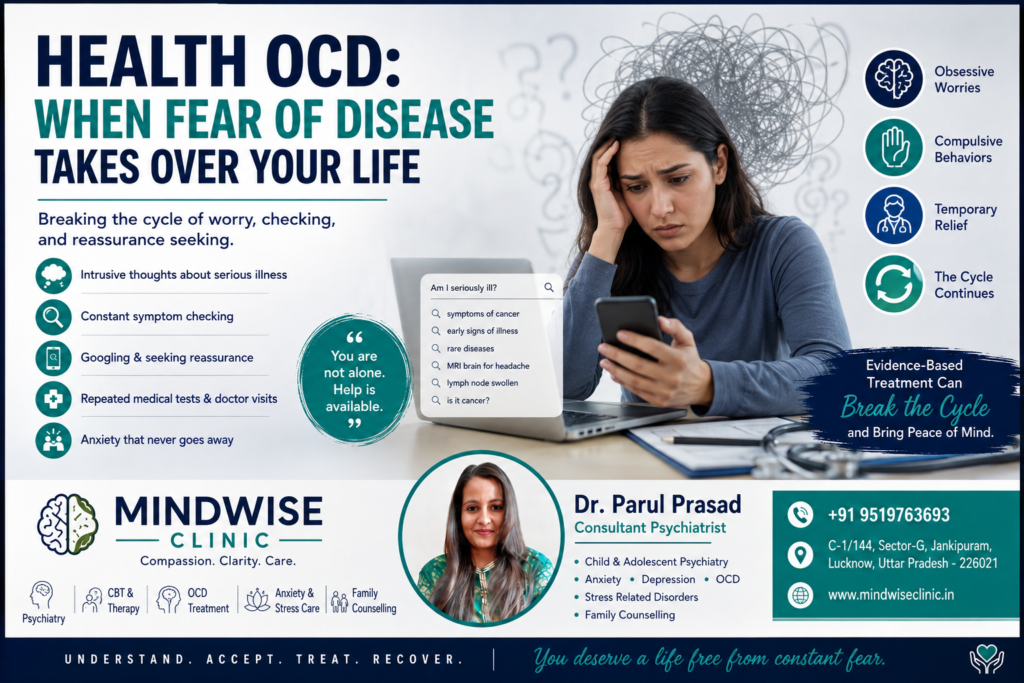
“Doctor, I know my reports are normal… but I still feel like something is seriously wrong.”
“I keep checking my body for lumps.”
“Every headache makes me think I have a brain tumour.”
“I spend hours searching symptoms on Google.”
“Even after multiple doctors tell me I’m healthy, I still don’t feel reassured.”
If these thoughts sound familiar, you may be experiencing
Health OCD (Health-Related Obsessive-Compulsive Disorder) rather than simply being “overly worried.”
Many people believe that OCD only involves excessive handwashing or repeatedly checking locks. In reality, OCD can affect almost any area of life—including your health. People with Health OCD become trapped in an exhausting cycle of intrusive fears, repeated body checking, endless internet searches, medical tests, and temporary reassurance that never truly lasts.
At
Mindwise Clinic,
Dr. Parul Prasad, Consultant Psychiatrist, frequently helps individuals who spend hours worrying about life-threatening illnesses despite repeated normal medical evaluations. The fear is real, the anxiety is intense, and without proper treatment, it can significantly affect relationships, work, sleep, and quality of life.
What Is Health OCD?
Health OCD is a subtype of
Obsessive-Compulsive Disorder (OCD) in which a person experiences persistent, unwanted, intrusive thoughts about having or developing a serious medical illness.
Unlike ordinary health concerns, these fears continue even after:
- Normal blood tests
- Normal scans
- Multiple medical opinions
- Reassurance from family
- Reassurance from doctors
The brain continues to ask:
- “What if they missed something?”
- “What if this is cancer?”
- “What if the reports are wrong?”
- “Maybe I should get one more test.”
The uncertainty becomes unbearable.
Health OCD vs Normal Health Concerns
Everyone worries about their health occasionally. If you develop chest pain or persistent fever, seeking medical attention is sensible.
Health OCD is different.
| Normal Health Concern |
Health OCD |
| Concern reduces after medical evaluation. |
Anxiety returns within minutes or hours. |
| Trusts doctor’s opinion. |
Doubts every reassurance. |
| Occasional symptom checking. |
Constant body checking. |
| Searches information briefly. |
Googles symptoms for hours. |
| Moves on after normal reports. |
Continues believing something is wrong. |
The problem is
not the physical symptom.
The problem is the inability to tolerate uncertainty.
How Does Health OCD Begin?
Health OCD often develops gradually.
Some common triggers include:
A Family Member Becoming Seriously Ill
Watching a loved one suffer from cancer, heart disease, stroke, or another serious illness can make the brain become hypervigilant toward every physical sensation.
The Death of Someone Close
After losing someone unexpectedly, even minor symptoms may feel life-threatening.
COVID-19 Pandemic
The pandemic significantly increased health-related anxiety worldwide.
Many individuals developed excessive symptom monitoring that continued long after the pandemic.
Reading Medical Information Online
A harmless headache suddenly becomes:
- Brain tumour
- Stroke
- Aneurysm
- Meningitis
Not because these conditions are likely—but because the anxious brain focuses on worst-case possibilities.
Previous Medical Illness
Someone who genuinely experienced a serious illness may later become excessively fearful that it will return.
Common Symptoms of Health OCD
Although symptoms vary from person to person, most individuals experience several of the following.
Obsessions (Intrusive Thoughts)
People repeatedly think:
- “I have cancer.”
- “I have HIV.”
- “I have rabies.”
- “This headache means brain cancer.”
- “This mole is skin cancer.”
- “My heartbeat feels different.”
- “What if my kidneys are failing?”
- “What if doctors overlooked something?”
These thoughts appear suddenly and repeatedly.
Even when people recognize that the fears seem excessive, they struggle to dismiss them.
Compulsions (Behaviours Done to Reduce Anxiety)
To feel safe, individuals often perform rituals.
Repeated Googling
Searching:
- Symptoms
- Diseases
- Survival rates
- Rare illnesses
- Medical forums
Hours may be spent comparing symptoms with serious diseases.
Unfortunately, this almost always increases anxiety.
Repeated Doctor Visits
Many people visit:
- Physicians
- Specialists
- Emergency departments
Even after normal evaluations, they continue searching for another opinion.
Repeated Medical Testing
Examples include:
- MRI scans
- CT scans
- Blood investigations
- ECGs
- Cancer markers
- HIV tests
Normal reports provide relief for only a short period before doubt returns.
Body Checking
Checking repeatedly for:
- Lumps
- Swollen lymph nodes
- Moles
- Pulse rate
- Blood pressure
- Temperature
- Oxygen saturation
- Skin colour
- Eye changes
Some individuals examine themselves dozens of times every day.
Seeking Reassurance
Questions frequently asked include:
- “Do I look sick?”
- “Does this mole look dangerous?”
- “Can you feel this lump?”
- “Should I see another doctor?”
- “Are you sure this isn’t cancer?”
Although reassurance reduces anxiety briefly, the brain soon demands reassurance again.
The Dangerous Cycle of Health OCD
Health OCD follows a predictable cycle:
- A normal body sensation occurs (e.g., headache, stomach discomfort, muscle twitch).
- The brain interprets it as a sign of a serious disease.
- Anxiety increases rapidly.
- The person searches online, checks their body, or seeks reassurance.
- Anxiety decreases temporarily.
- Doubt returns: “What if they missed something?”
- The cycle repeats.
This cycle can occur many times a day and often becomes more severe without treatment.
Why Google Makes Health OCD Worse
One of the most common compulsions is repeatedly searching symptoms online.
For example:
A person searches:
“Headache causes.”
Within minutes, they read about:
- Brain tumours
- Stroke
- Brain haemorrhage
- Meningitis
The anxious brain ignores the fact that
tension headaches and migraines are far more common and instead focuses on the rarest, most frightening possibilities.
This creates a vicious cycle of fear, reassurance seeking, and more internet searching.
Can Health OCD Cause Physical Symptoms?
Yes.
Anxiety itself can produce real physical sensations, including:
- Headaches
- Muscle tension
- Dizziness
- Palpitations
- Chest tightness
- Stomach discomfort
- Nausea
- Tingling sensations
- Sweating
- Trembling
Ironically, these symptoms may then become the focus of further obsessive fears, reinforcing the OCD cycle.
Health OCD vs Illness Anxiety Disorder (Health Anxiety)
Many people confuse
Health OCD with
Illness Anxiety Disorder (IAD) because both involve excessive fear of illness. However, they are different conditions and require different therapeutic approaches.
| Health OCD |
Illness Anxiety Disorder (IAD) |
| Fear is driven by intrusive, unwanted obsessive thoughts. |
Fear is primarily based on a persistent belief of being ill. |
| Repetitive compulsions such as Googling symptoms, body checking, reassurance seeking, or repeated testing are central. |
Reassurance seeking may occur but compulsions are less ritualistic. |
| Thoughts often begin with “What if…?” |
The person genuinely believes they are already ill or will soon become ill. |
| Anxiety temporarily reduces after compulsions but quickly returns. |
Anxiety may fluctuate but is less dependent on rituals. |
| ERP (Exposure and Response Prevention) is the gold-standard psychological treatment. |
CBT focusing on health beliefs is often used. |
Many individuals actually have
both Health OCD and Health Anxiety, which is why a comprehensive psychiatric assessment is important before beginning treatment.
The Neuroscience Behind Health OCD
Health OCD is
not a sign of weakness or lack of willpower. It is associated with changes in specific brain circuits involved in fear, decision-making, and habit formation.
Research has identified abnormalities in the
Cortico-Striato-Thalamo-Cortical (CSTC) Circuit, which includes:
- Orbitofrontal Cortex (OFC)
- Anterior Cingulate Cortex (ACC)
- Caudate Nucleus
- Thalamus
These regions are responsible for:
- Detecting danger
- Assessing uncertainty
- Stopping repetitive thoughts
- Inhibiting compulsive behaviours
In OCD, this “alarm system” becomes overactive. The brain repeatedly signals that something may be wrong, even when there is no real threat.
Neurotransmitters such as
serotonin,
glutamate, and
dopamine are also involved, which explains why certain medications can be effective.
Common Types of Health OCD
Health OCD can focus on almost any disease.
Cancer OCD
Every mole, lump, or unexplained ache becomes a source of fear.
People may repeatedly:
- Check their skin
- Feel for swollen lymph nodes
- Request scans
- Read cancer survivor stories
- Compare symptoms online
HIV OCD
One of the most common presentations seen in psychiatric practice.
Examples include:
- Fear after a protected sexual encounter
- Fear after touching public objects
- Fear of contaminated needles
- Repeated HIV testing despite negative reports
- Constant online searching about HIV symptoms
Some individuals undergo testing multiple times despite being told there was no significant risk.
Rabies OCD
A surprisingly common subtype.
Examples:
- Fear after a dog barked nearby
- Fear after touching a surface where an animal may have been
- Fear of unnoticed scratches
- Repeatedly examining the skin
- Seeking vaccination without medical indication
Heart Attack OCD
Every heartbeat becomes a source of worry.
Individuals repeatedly:
- Measure pulse
- Check blood pressure
- Visit emergency departments
- Request ECGs
- Wear smartwatches constantly
Brain Tumour OCD
Common symptoms include:
- Headache
- Dizziness
- Eye strain
- Forgetfulness
The individual immediately fears:
- Brain tumour
- Stroke
- Aneurysm
Even after normal MRI scans, doubts persist.
Neurological Disease OCD
Some people become convinced they have:
- Multiple sclerosis (MS)
- ALS (Motor Neuron Disease)
- Parkinson’s disease
- Dementia
Minor muscle twitches or temporary numbness become interpreted as catastrophic illnesses.
Risk Factors for Developing Health OCD
Health OCD does not develop because someone is “weak.”
Several factors increase vulnerability.
Genetics
Having a family history of:
- OCD
- Anxiety disorders
- Depression
may increase the risk.
Personality Traits
Individuals who are:
- Highly responsible
- Perfectionistic
- Sensitive to uncertainty
- Detail-oriented
may be more susceptible.
Childhood Experiences
Growing up in environments where:
- Illness was frequently discussed
- Parents were overly anxious about health
- Medical emergencies occurred
can shape later beliefs about danger.
Trauma
Serious illness, accidents, or witnessing a loved one’s medical condition can contribute to Health OCD.
Excessive Internet Use
Repeated exposure to alarming medical information often fuels obsessive fears.
How Health OCD Affects Daily Life
Many people underestimate how disabling Health OCD can become.
Individuals may spend:
- 4–8 hours daily searching symptoms
- Visiting multiple doctors
- Avoiding work
- Cancelling holidays
- Avoiding exercise
- Constantly monitoring bodily sensations
Relationships often suffer because family members become trapped in repeated reassurance.
Partners may hear questions like:
- “Do you think I’m dying?”
- “Can you check this mole again?”
- “Should I go to another hospital?”
Eventually, reassurance no longer helps.
Why Reassurance Doesn’t Work
Most people assume reassurance is helpful.
Unfortunately, in OCD, reassurance becomes another
compulsion.
Example:
Person:
“Doctor, are you sure this isn’t cancer?”
Doctor:
“Your tests are completely normal.”
Relief lasts…
- 10 minutes
- One hour
- One day
Then another thought appears.
“What if this cancer didn’t show on that scan?”
The brain demands reassurance again.
Every reassurance strengthens the OCD cycle.
How Is Health OCD Diagnosed?
A psychiatrist performs a detailed assessment that includes:
- Current symptoms
- Duration
- Frequency of intrusive thoughts
- Compulsive behaviours
- Medical history
- Psychiatric history
- Family history
- Functional impairment
Diagnosis is based on internationally accepted criteria such as
DSM-5-TR and
ICD-11, while also ensuring that genuine medical conditions are not overlooked.
Evidence-Based Treatment for Health OCD
The encouraging news is that
Health OCD is highly treatable, especially when identified early.
Treatment typically combines psychotherapy, education, and—when clinically indicated—medication.
1. Cognitive Behavioural Therapy (CBT)
CBT helps individuals recognise how obsessive thoughts influence emotions and behaviours.
Therapy focuses on:
- Identifying thinking errors
- Challenging catastrophic interpretations
- Reducing reassurance-seeking
- Building tolerance for uncertainty
2. Exposure and Response Prevention (ERP)
ERP is considered the
gold-standard psychological treatment for OCD.
Instead of escaping anxiety, the person gradually learns to experience uncertainty
without performing compulsions.
Examples include:
- Not Googling symptoms after noticing a headache
- Delaying body checking
- Avoiding repeated reassurance from family
- Resisting unnecessary medical appointments when medically appropriate
Initially, anxiety rises, but over time it naturally decreases as the brain learns that uncertainty can be tolerated without rituals.
3. Medication
For individuals with moderate to severe OCD, medication may be recommended as part of a comprehensive treatment plan.
Commonly used medications include certain
Selective Serotonin Reuptake Inhibitors (SSRIs), prescribed under psychiatric supervision. In some cases, additional medications may be considered depending on symptom severity and response to treatment.
Medication decisions are individualised after a full psychiatric evaluation.
4. Family Education
Family members often unintentionally maintain OCD by providing repeated reassurance.
Learning how to respond supportively—without participating in compulsions—is an important part of recovery.
Lifestyle Strategies That Support Recovery
While lifestyle changes do not replace professional treatment, they can complement it:
- Maintain a regular sleep schedule
- Exercise consistently
- Practice mindfulness or relaxation techniques
- Limit repeated symptom searching online
- Reduce excessive caffeine if it worsens anxiety
- Follow up regularly with your treating psychiatrist or therapist
Can Health OCD Be Cured?
Many people experience
significant improvement with evidence-based treatment. Some become symptom-free for long periods, while others learn effective strategies to prevent relapse.
Recovery does not mean never having an intrusive thought again—it means learning that these thoughts no longer control your life.
When Should You Seek Professional Help?
Consult a psychiatrist if you:
- Spend more than an hour a day worrying about illness
- Repeatedly seek reassurance despite normal evaluations
- Frequently Google symptoms
- Undergo repeated medical tests without clear medical indications
- Avoid work, travel, or relationships because of fear of illness
- Feel overwhelmed by anxiety or intrusive thoughts
Early treatment can prevent OCD from becoming more entrenched and improve quality of life.
Final Thoughts
Health OCD is far more than “being overly cautious.” It is a recognised form of Obsessive-Compulsive Disorder in which intrusive fears about serious illness become relentless and exhausting. Although reassurance, body checking, and endless internet searches may offer temporary comfort, they ultimately strengthen the cycle of anxiety.
At
Mindwise Clinic,
Dr. Parul Prasad, Consultant Psychiatrist, provides comprehensive assessment and evidence-based treatment for OCD and related anxiety disorders. With timely diagnosis, Cognitive Behavioural Therapy (CBT), Exposure and Response Prevention (ERP), appropriate medication when indicated, and family support, individuals with Health OCD can regain confidence, reduce compulsions, and lead fulfilling lives.
Frequently Asked Questions (FAQs) About Health OCD
1. Is Health OCD the same as being a hypochondriac?
Not exactly.
The term
“hypochondriac” is outdated and no longer used as a medical diagnosis.
Health OCD is a subtype of
Obsessive-Compulsive Disorder, whereas Illness Anxiety Disorder is a separate diagnosis. Although they share similarities, Health OCD is characterized by intrusive obsessive thoughts and repetitive compulsions such as Googling symptoms, checking the body, and repeatedly seeking reassurance.
2. Can Health OCD cause real physical symptoms?
Yes.
The anxiety associated with OCD can produce genuine physical symptoms, including:
- Chest tightness
- Headaches
- Muscle pain
- Tremors
- Palpitations
- Stomach discomfort
- Dizziness
- Tingling sensations
- Sweating
- Breathlessness
Ironically, these symptoms often become the focus of further obsessive fears.
3. Why do I keep Googling symptoms even when I know it makes me anxious?
Because
Googling is a compulsion.
Your brain temporarily feels safer after reading medical information.
Unfortunately, that relief lasts only a short time before another doubt appears.
The brain learns:
Anxiety → Google → Temporary Relief
This strengthens OCD over time.
4. Should I stop Googling symptoms completely?
If Googling has become repetitive and compulsive, reducing it is an important part of recovery.
During CBT and ERP, therapists often help patients gradually reduce symptom searching while learning to tolerate uncertainty.
5. Can stress make Health OCD worse?
Yes.
Health OCD often becomes more severe during periods of:
- Examination stress
- Relationship problems
- Job pressure
- Pregnancy
- Loss of a loved one
- Medical illnesses
- Financial stress
Stress increases the frequency of intrusive thoughts.
6. Is Health OCD common?
Yes.
Health-related obsessions are among the most common OCD themes encountered in psychiatric practice.
Many individuals experience symptoms for years before receiving the correct diagnosis because they repeatedly seek medical evaluations rather than psychiatric assessment.
7. Can children and teenagers develop Health OCD?
Yes.
Children may repeatedly ask:
- “Am I going to die?”
- “What if I get cancer?”
- “Can germs make me sick?”
They may repeatedly wash, seek reassurance, or refuse school due to health fears.
Early intervention significantly improves outcomes.
8. Can OCD affect different themes over time?
Absolutely.
Someone who previously worried about contamination may later develop fears about:
- Cancer
- HIV
- Rabies
- Heart disease
- Relationships
- Religion
- Harm
- Sexual intrusive thoughts
The theme changes.
The OCD process remains the same.
9. Is medication always necessary?
Not always.
Some individuals improve significantly with
CBT and ERP alone.
Others, particularly those with moderate to severe symptoms, may benefit from medication in combination with psychotherapy.
Treatment is individualized after psychiatric evaluation.
10. Can Health OCD be completely controlled?
Yes.
With evidence-based treatment, many people experience dramatic improvement and return to normal work, studies, and family life.
Early diagnosis generally leads to better outcomes.
Myths vs Facts About Health OCD
| Myth |
Fact |
| OCD is only about cleanliness. |
OCD has many forms, including Health OCD, Relationship OCD, Harm OCD, Religious OCD, and more. |
| People with Health OCD are imagining symptoms. |
Anxiety can produce genuine physical sensations that feel very real. |
| More medical tests always reduce anxiety. |
Excessive testing often reinforces OCD and provides only temporary relief. |
| Googling symptoms helps identify diseases early. |
Compulsive Googling commonly increases anxiety and maintains OCD. |
| Health OCD means someone is “crazy.” |
Health OCD is a recognized psychiatric disorder that is treatable. |
| People with OCD can stop worrying if they try harder. |
OCD is a neuropsychiatric condition requiring appropriate treatment and support. |
A Real-Life Example (Illustrative Case)
Rahul (name changed), a 29-year-old software engineer, visited our clinic after spending nearly
five hours each day searching for symptoms online.
It started with occasional headaches.
Soon, he became convinced he had a brain tumour.
Despite:
- Two normal MRI scans
- Multiple neurological consultations
- Normal blood investigations
he continued believing that something serious had been overlooked.
Every morning he checked his pupils in the mirror.
Every evening he searched:
- “Early signs of brain cancer”
- “Can MRI miss a tumour?”
- “Brain tumour without symptoms”
His anxiety became so severe that he stopped going to work regularly.
Following a comprehensive psychiatric evaluation, he was diagnosed with
Health OCD.
Through
CBT,
Exposure and Response Prevention (ERP), psychoeducation, and appropriate medication, Rahul gradually reduced his compulsive Googling, stopped repeatedly seeking reassurance, and returned to work with significantly improved quality of life.
(This is an illustrative example created for educational purposes and does not describe an actual patient.)
How Families Can Help Someone with Health OCD
Family members often feel exhausted because they are repeatedly asked questions such as:
- “Does this mole look bigger?”
- “Do you think I have cancer?”
- “Can you check my neck once more?”
- “Should I see another doctor?”
Although reassurance is given with love, repeated reassurance often strengthens OCD.
Instead, families can:
- Encourage treatment adherence.
- Support therapy homework.
- Avoid participating in repetitive checking rituals.
- Validate the person’s distress without confirming obsessive fears.
- Celebrate progress rather than perfection.
- Learn about OCD through reliable educational resources.
Recovery is often faster when families are actively involved in treatment.
When to Seek Immediate Professional Help
Arrange an urgent psychiatric assessment if Health OCD is causing:
- Severe depression
- Panic attacks
- Social isolation
- Inability to attend work or school
- Excessive medical investigations
- Financial strain due to repeated testing
- Self-harm thoughts
- Suicidal thoughts
Early intervention can prevent years of unnecessary suffering.
About Mindwise Clinic
At
Mindwise Clinic, we understand that obsessive fears about health are not “attention-seeking” or “overreacting.” They are symptoms of a treatable mental health condition.
Dr. Parul Prasad
Consultant Psychiatrist
We provide comprehensive evaluation and treatment for:
- Obsessive-Compulsive Disorder (OCD)
- Health OCD
- Relationship OCD (ROCD)
- Contamination OCD
- Harm OCD
- Anxiety Disorders
- Panic Disorder
- Depression
- Stress-related Disorders
- Child & Adolescent Psychiatry
- Family Counselling
- Cognitive Behavioural Therapy (CBT)
- Exposure and Response Prevention (ERP)
Our approach is evidence-based, compassionate, confidential, and tailored to each individual’s needs.
References
- American Psychiatric Association. Diagnostic and Statistical Manual of Mental Disorders, Fifth Edition, Text Revision (DSM-5-TR).
- World Health Organization. International Classification of Diseases 11th Revision (ICD-11).
- National Institute for Health and Care Excellence (NICE). Obsessive-compulsive disorder and body dysmorphic disorder: treatment guidelines.
- International OCD Foundation (IOCDF). Clinical resources on OCD and Exposure and Response Prevention.
- National Institute of Mental Health (NIMH). Obsessive-Compulsive Disorder.
Disclaimer
This article is intended for educational purposes only and should not be used as a substitute for professional medical advice, diagnosis, or treatment. If you or a loved one experiences persistent intrusive thoughts, compulsive behaviours, or overwhelming health-related anxiety, consult a qualified mental health professional. In the event of severe distress, suicidal thoughts, or an emergency, seek immediate medical assistance. Early diagnosis and evidence-based treatment can significantly improve recovery and quality of life.
Related services at Mindwise Clinic: Psychological Testing, Counseling & Therapy.
A note on this article: This content is for general educational purposes and is not a substitute for professional medical advice, diagnosis, or treatment. If you are experiencing a mental health crisis or need urgent help, please contact a local emergency service or a crisis helpline directly — such as India's KIRAN mental health helpline: 1800-599-0019 (toll-free, 24/7).